There’s a particular kind of anxiety that comes from refreshing your CRM and seeing nothing move. The same deals are still at the same stage, and prospects who seemed ready are now “reconsidering based on market conditions.” Sales slump suck, and I hear you.
I have lived through these moments more times than I can count, especially in investment sales, when one shift in the market can slow conversations that felt certain just weeks before.
When this happens, most of us react the same way and forget that in most cases, something has shifted beneath the surface, and until we identify it, progress will feel harder than it should.
If you are stuck in that cycle of stalled deals and slipping numbers, I’ll walk you through 11 practical steps you can apply this week to regain control of your process and start seeing progress again.
Let’s dive in!
How to identify the type of sales slump you’re in
One of the most common mistakes sales reps make is assuming every slump is the same, as the indicators seem the same. But not all sales slumps are caused by the same problem, and applying the wrong fix can waste weeks.
In B2B SaaS, for example, a sales rep might think they have a pipeline problem because bookings are down, but in reality, the issue could be conversion. Leads are entering the funnel, but they are not progressing from MQL to SQL. Or opportunities are being created, but the win rate has quietly dropped below segment benchmarks. Without diagnosing where the breakdown is happening, effort gets misdirected.
Before jumping into solutions, it helps to understand the different types of sales slumps. Let’s look at them:
1. Pipeline slump
This happens when not enough qualified opportunities are entering your funnel. You may see fewer MQLs, fewer SQLs, or fewer booked discovery calls. The problem sits at the top of the funnel and usually reflects targeting, positioning, or lead quality issues.
2. Conversion slump
Opportunities exist, but they are not progressing through stages at normal rates. In B2B SaaS, this often shows up as weak MQL-to-SQL conversion or a drop in the opportunity-to-close percentage. Activity is happening, but deals are stalling.
3. Late-stage slump
Deals reach proposal, security review, or procurement, and then slow down dramatically. In CRM data, this shows up as extended stage duration and slipping close dates. This is often tied to proposal clarity, stakeholder alignment, or decision friction.
4. Win-rate slump
Your close rate drops below your historical baseline or below industry benchmarks for your segment. For example, if SMB SaaS deals typically close at 28 to 45 percent and your rate has fallen to 15 percent over multiple months, that is not random variance, but a slump that can be measured.
5. Sales cycle slump
Your win rate may be steady, but deals are taking much longer to close. Median B2B SaaS sales cycles sit around 84 days across segments, with SMB deals often closing within 14 to 30 days and enterprise deals taking 90 to 180 days. If your cycle time drifts significantly beyond these ranges while win rates fall, that combination is a strong signal of a sustained slump.
Once you know the type of slump, the next step is to check whether your numbers are actually out of line with typical B2B SaaS performance. Benchmarks prevent you from treating normal variance as a crisis or from ignoring a real problem.
Below are the B2B SaaS sales benchmarks by slump type:
| Slump type | Metric to check | Typical B2B SaaS benchmark range | How to read it |
|---|---|---|---|
Pipeline slump | Visitor to lead / signup | ~1–3% average; 8–15% top performers | Well below ~2% with steady traffic to pipeline issues, not just a slow month. |
Pipeline slump | MQL volume vs target | Steady or growing in healthy orgs Look at your CRM/marketing dashboard (compare quarter-over-quarter trends) | Sharp MQL drop with same spend/traffic to top-of-funnel slump. |
Conversion slump | MQL to SQL | ~30–40% in aligned B2B SaaS teams | Single digits/low-teens for weeks to conversion slump. |
Conversion slump | SQL to Opp / Opp to Close | SQL to Opp ~40%+; Opp to Close ~20–30% | Big drop vs historical/these ranges to conversion issue. |
Late-stage slump | Time in final 2–3 stages | Within normal cycle for segment | Late stages ballooning while early stages normal to late-stage slump. |
Win-rate slump | Win rate (SMB/mid-market) | ~30–40% on well-qualified SMB deals | 10+ points below for months to win-rate slump. |
Win-rate slump | Win rate (enterprise) | ~15–25% for high-ACV B2B SaaS | Sustained drop below segment norm to win-rate slump. |
Sales-cycle slump | Cycle length (SMB) | ~14–30 days | Regularly past 45–60 days to cycle slump. |
Sales-cycle slump | Cycle length (mid-market) | ~30–90 days | Most deals past 120 days to cycle slump. |
Sales-cycle slump | Cycle length (enterprise) | ~90–180+ days | 200–250+ days w/o scope change to cycle slump. |
*See sources for benchmarks in footnotes
We recommend exporting these metrics from your CRM by month/cohort. When actuals sit 10–20% outside these bands for 2+ months, match what you feel (e.g. “everything is slow”) to where the numbers are actually breaking (pipeline, conversion, late stage, win rate, or cycle length).
Top 11 strategies for breaking out of sales slumps
1. Focus on the fundamentals
Focusing on sales fundamentals is often the fastest way to steady performance. Why? Because when results dip, it is rarely because your entire strategy stopped working overnight. More often, small execution habits change without you noticing.
Maybe the calls become less structured, emails become more generic, or follow-ups become shorter or more hesitant. Those small shifts compound. If that’s the case, here are a few tactics to apply:
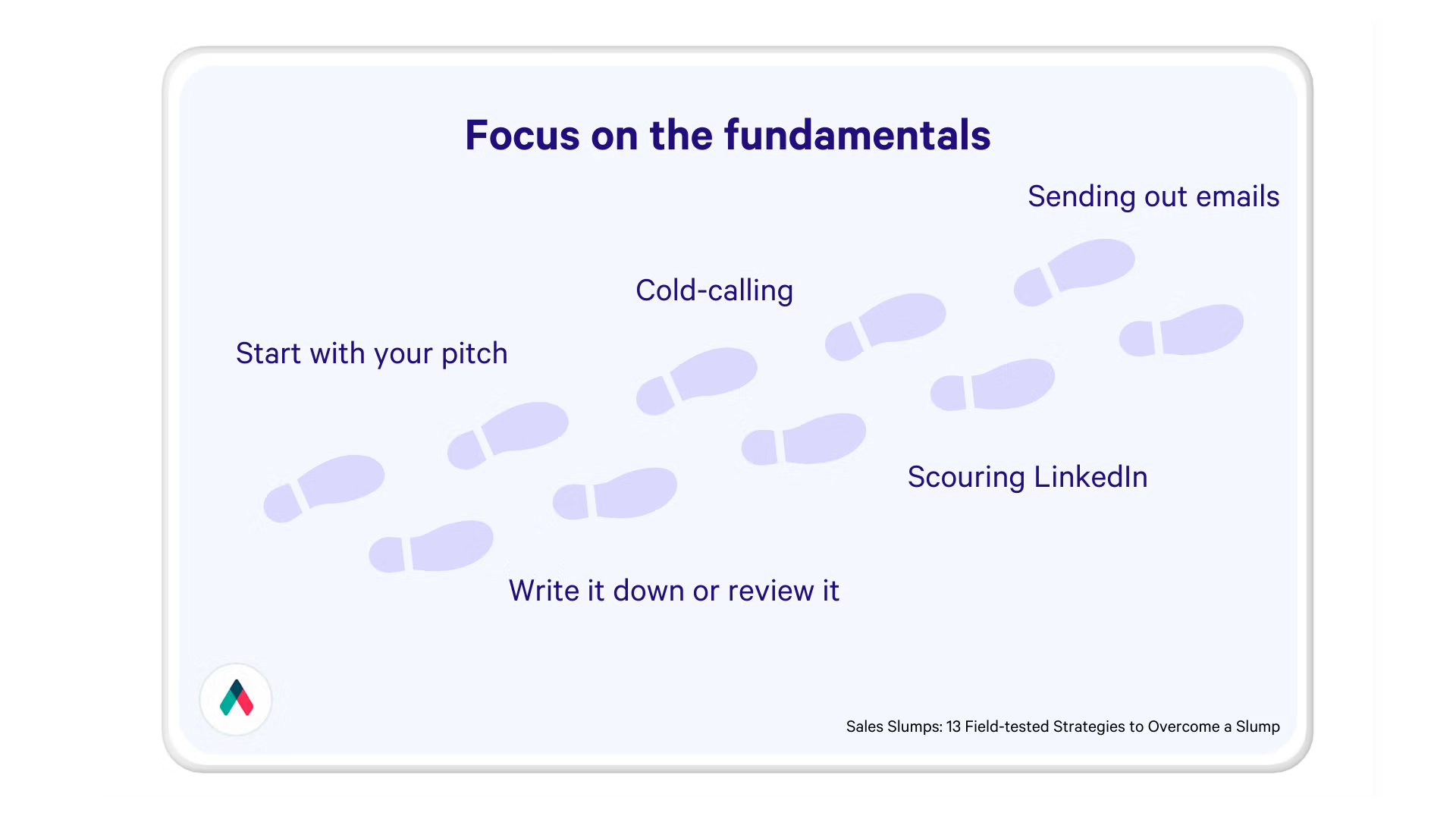
- Start with your pitch. Write it out exactly as you are delivering it today. Is it clear what problem you solve? Can a buyer understand the value in the first few sentences? Compare it to a pitch you used during a stronger month. What is different?
- Next, review your cold calls and cold emails. Are you leading with a clear reason for reaching out, or a generic introduction? A message tied to a specific problem or trigger event will outperform a routine outreach every time.
- Then look at your follow-ups. Are you restating the business impact discussed on the call, or simply asking if they have had time to review?
Sales fundamentals are the basics of how you start conversations, explain value, and move to the next step. When those basics are clear and consistent, results stabilize.
2. Isolate the key drivers and diagnose before you change tactics
In the midst of a sales slump, it's essential to dissect your sales funnel to identify the weakest links. Instead of guessing, walk your funnel deliberately from top to bottom and ask one simple question at each stage: What changed?
This process involves a meticulous analysis of each stage – from lead generation to closing deals.
- At the top of the funnel, look at quality and targeting. Are the leads entering your pipeline aligned with your ideal customer profile, or are you spending time on accounts that were never strong fits to begin with?
- In the middle of the funnel, examine progression. Are discovery calls turning into real opportunities at the same rate as before? Are proposals being generated at a normal pace, or are conversations stalling after initial interest?
- At the bottom of the funnel, study decision friction. Are deals taking longer to move from proposal to close? Are objections repeating? Are close dates slipping forward without clear next steps?

As Tallan Shrimpton, Senior Account Executive at Salesforce, puts it:
“Don’t make it personal. Use the data to quantify and position underperformance as an opportunity for improvement.”
In essence, your goal is not to find ten issues, but to identify the first stage at which performance deviated from your baseline. That is where the slump began.
Pro-tip: Enhancing post-discovery engagement with effective sales collateral
A significant number of deals get lost post-discovery, often due to a lack of continued engagement. To prevent this, focus on enhancing your interactions with buyers using effective sales collateral. Tools like Qwilr can be instrumental in this phase. Qwilr’s platform allows you to create compelling, interactive proposals and presentations that keep potential customers engaged and informed.
By providing visually appealing and informative sales collateral, you can maintain the momentum gained during the discovery phase. This not only helps in keeping the deal alive but also positions your offering more favorably in the minds of potential clients.
3. Start small and create momentum fast
If it has been a slow month, your instinct may be to chase the largest deal in your pipeline to close the gap quickly. It feels logical as bigger deals move you closer to quota in one move. The problem is that larger investments usually involve longer sales cycles, more stakeholders, and deeper internal review.
In B2B SaaS, mid-market and enterprise deals often span multiple months, especially when procurement and security are involved.
When you are in a slump, time and probability matter more than deal size. So, instead of aiming for the biggest swing, look for the fastest path to a decision, review your CRM for recently active accounts, opportunities in proposal or review, and existing customers where expansion is realistic. These deals already carry context and relationship equity.
Pull five opportunities that have moved in the last 30 days and identify the one missing step. Then send a direct next-step message that forces clarity rather than another open-ended follow-up.
4. Deconstruct your closed deals
When performance dips, the usual advice is to look outward. Watch a webinar, follow a well-known sales voice, or study what top performers in other companies are doing. There is nothing wrong with that, but those people are not selling your product to your market or to your buyers.
The most relevant insight usually sits closer to home, and instead of searching for new tactics, deconstruct what is already converting inside your team. Here’s a framework to use:
Review one recently closed deal and break it down:
- How was the business problem framed?
- Where was urgency or timeline confirmed?
- How was the next step secured before the call ended?
Then analyze a winning email thread:
- How many sentences before the call to action?
- Is the ask binary or open-ended?
- How are objections acknowledged and reframed?
Finally, examine a proposal that closed:
- Where is pricing introduced?
- How is risk addressed?
- Is the next step specific and dated?
Pull three wins and three stalled deals from the same period and compare the structure. If patterns repeat in wins but not in losses, you have identified something transferable!
5. Try something new
If you have been executing consistently and the results are still flat, it may be time to run a controlled experiment, with one specific change and a clear metric.
Pick a single variable and test it for five working days.
If outbound has been email-heavy, test a short LinkedIn voice note and measure the reply rate. If discovery calls feel repetitive, test a stronger opening question such as, “What happens if this problem is not solved this quarter?” Track whether urgency improves.
If proposals are being viewed but not progressing, experiment with how you present them. Instead of sending a document and waiting, embed a short Loom video walking through the key sections. Add a clear implementation timeline or a simplified pricing breakdown. Make the next step explicit and easy to act on.
For teams using Qwilr, embedding video, interactive pricing, and clear call-to-action buttons can be done directly inside the proposal, making it easier to test different presentation styles without rebuilding everything.
Sometimes the payoff from experimenting with your proposal format shows up later than you'd expect. Matt Anson, SEO Manager at STAFFLINK, learned this firsthand.
"We sent a proposal to a prospect who wanted a website redesign — they decided to explore other options. Six months later, I got an alert that the prospect had reopened the original proposal. I reached back out, and eventually they signed up for more than we had originally pitched them."
There are plenty of ways you can switch things up. The main thing is just to stay open to new ideas and be willing to test them out. If something doesn’t work, move on to the next effort until you find something that does.
6. Create a clear action plan for each day
When sales slump, it is easy to fall into reactive work, because uncertainty changes how you spend your time. You start replying to emails quickly because it feels productive. You update CRM fields. You chase small tasks that give you a sense of control.
Meanwhile, the heavier work, like asking for a decision or moving a late-stage deal forward, gets delayed. That is why we recommend deciding in advance what must move today.
So, for example, at the start of each morning, write down three to five specific sales tasks. Not “make calls,” but “call John at ACME to confirm security review timeline.” Not “follow up,” but “send proposal recap to Sarah with implementation steps and next-step date.”
Then structure your day with clear blocks:
- 60 to 90 minutes moving late-stage deals forward
- 60 minutes creating new pipeline
- 30 minutes reviewing a call or refining an email
- 15 minutes capped for admin
This way, you can track how much progress you’re making, and it’ll help you stay motivated. The key to sales motivation is to get started and not give up. You may not always get your daily to-dos done (only 53.5% of planned tasks get completed ).
Even so, you'll be able to make some progress and see results, which matters tremendously when you're in a sales slump.
7. Set effort-based expectations
When you are in a slump, it can feel personal. It can feel like you are the only one behind. The broader data suggest otherwise.
According to the HubSpot State of Sales 2025 report, 91 percent of sellers say their win rates and close rates have either increased or stayed flat over the past year. Ninety-three percent report that average deal size has remained stable or grown, and 68 percent say lead quality has improved.
Many sellers who hit 75 percent or less of quota in 2024 still expect to reach 76 to 99 percent or even exceed quota in 2025.
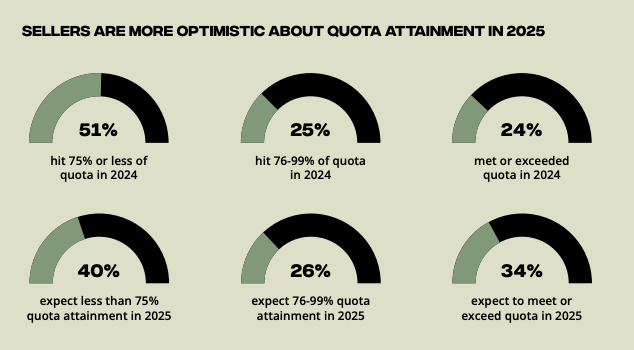
As you can see, you are not alone in temporary dips. Most sellers experience variability without long-term decline. That is why shifting from outcome-based goals to effort-based expectations matters.
Instead of focusing on “closing three deals,” focus on actions you fully control:
- Book five discovery calls
- Send three well-structured proposals
- Complete ten high-quality follow-ups
- Map decision-makers in two active accounts
By making that adjustment, you get back in the driver’s seat and have more say over hitting those goals. Having agency over your decisions can help boost confidence.
8. Run a thorough process analysis
When a slump drags on, guessing wastes time. Instead of changing tactics at random, we recommend auditing your process from prospecting to close and identifying friction points.
Start by picking one recent win and one stalled deal. Walk them stage by stage. Where did the stalled deal slow down? Was it a slow proposal turnaround? An unclear next step? Internal approvals stretching timelines? A buyer going quiet after reviewing pricing?
Print this table and complete it with real examples from your pipeline:
Deal Health Check
Review each stage of your pipeline. Identify what's stalling and pick one fix per stage for this week.
| Stage | What's happening | Likely cause | Fix this week |
|---|---|---|---|
| Prospecting | |||
| Discovery | |||
| Proposal | |||
| Close |
As you fill it in, be specific. Not “low engagement,” but “proposal viewed once, no follow-up call booked.” Not “slow process,” but “security review took 18 days.”
The goal is not to diagnose everything, but to identify one stage where deals consistently slow and commit to fixing that first.
Late-stage friction often increases when proposals are rebuilt from scratch each time, creating delays and inconsistent messaging. Tightening your proposal workflow, whether through clearer templates or tools like Qwilr that standardize structure and track engagement, can remove unnecessary drag.
9. Concentrate on helping customers
Many sales reps focus on closing deals, and it is easy to see why. Business goals are tied to quota and revenue. But when every interaction is about “getting the deal,” buyers often slow down because they feel the pressure.
Instead of pushing for a close, focus on helping them make a clear decision. A few ways to do this are:
- Start by helping your champion internally. After a call, send a short summary that they can forward to other stakeholders. Include the business problem, the financial or operational impact, the recommended solution, and the expected timeline. Make it easy for them to advocate without rewriting your pitch.
The goal is to give your champion everything they need to sell your offer internally — and that starts with how you present it. As Alex Dutton, Sales Director at Brisant Secure, puts it:
"So much of what we do is on the value-add side, providing genuine benefits to our customers. Sending a Qwilr page that contains a quote alongside all the relevant context allows us to communicate our offering more effectively and sell when we're not in the room."
- Next, remove one risk before it becomes an objection. Address implementation effort, time to value, or internal disruption directly in your follow-up. Buyers hesitate when the unknowns feel larger than the benefits.
- Finally, clarify decision criteria. Ask, “What would need to be true for this to move forward?” This surfaces real blockers instead of surface-level hesitation.
Ultimately, when buyers feel supported rather than pressured, decisions happen faster.
10. Ask for help from the right people
When a slump stretches on, the instinct is to power through alone, but this approach usually slows progress. The key is not just asking for help, but asking the right person for the right problem.
If a deal feels stuck strategically, bring it to your manager with three specific questions. For example: “Are we talking to the right stakeholder?” “Is pricing the real blocker?” “Should this be deprioritized?” Asking clear questions produces clear direction.
If messaging feels weak, involve enablement or marketing. Ask for one winning email thread or a proposal that recently closed. Study structure and positioning, not just wording. If deals consistently stall at the same stage, speak with RevOps. There may be workflow friction, approval delays, or CRM process gaps affecting multiple reps.
Finally, if objections are repeating, shadow a top performer and listen for how they handle hesitation and secure next steps.
The goal is not more opinions, but targeted input that removes a specific bottleneck.
Here’s how you can engage the right people in your org:
| Role | When to ask | What to ask |
|---|---|---|
Manager | Deal strategy unclear | “What am I missing in this account?” |
Enablement | Messaging not landing | “Can I see a winning version of this?” |
RevOps | Stage delays repeat | “Where is the process slowing us down?” |
Peer | Objections repeating | “How do you handle this pushback?” |
Up to this point, we’ve focused on mechanics. Pipeline, process, messaging, next steps. But even the best system won’t work
11. Focus on mindfulness
And finally, focus on mindfulness. More often than not, sales slumps start with losing a positive mindset, and hence, you have to be honest, yet positive with yourself. Reflect on your sales performance and focus on what you can do differently. This will help you assess yourself correctly and adjust those parts of your mindset that may not serve you well.
For instance, some mindset-related issues that could prevent you from performing at your best include:
- Low self-confidence and, therefore, low sales confidence
- Focusing on just the numbers and not enjoying the process
- Getting too attached to outcomes
- Lack of focus or staying too long on a single task
- Lack of measurable and attainable sales goals
- Putting too much pressure on yourself
- Low sales productivity
All of these mindset-related issues can get in the way of closing deals, but they are 100% addressable when you have a growth-oriented attitude and want to be better, as opposed to sticking to your old ways.
Turn your sales slump into your fuel for sales success
There are very few positives about sales slumps: they are energy-consuming, shoot right through your self-confidence, put your sales activities on a seemingly endless bad path, and can make you feel like a complete failure. But if you take the right approach, it can become your most significant catalyst to success
Identify where the slowdown is happening. Pick two or three focused actions, track the leading indicators that show progress before revenue catches up. Stay close to the process and make small, deliberate adjustments. That’s usually enough to steady things.
And if proposals are the stage where deals tend to stall, we’d love to show you how Qwilr can help. As Andrew Thomas, Head of Marketing at Destined, puts it:
"Our sales team can spend more time selling and focusing on the needs of our customers, our pipeline is more predictable, our contracts are closing faster and at a higher rate, and we can better forecast billable hours."
Book a demo to see how your team can build and send them effectively, too.
Sources:
About the author

Taru Bhargava|Content Strategist & Marketer
Taru is a content strategist and marketer with over 15 years of experience working with global startups, scale-ups, and agencies. Through taru&co., she combines her expert skills in content strategy, brand management, and SEO to drive more high-intent organic traffic for ambitious brands. When she’s not working, she’s busy raising two tiny dragons. She's on a first-name basis with Mindy Kaling.
FAQs
Many things can cause a sales slump, including changes in the market, new competitors, poor communication, outdated sales practices, not having the best sales tools at disposal and a negative mindset.
Analyzing past sales is crucial. It reveals patterns and guides improvements. Understand what worked, learn from what didn’t, and use these insights to refine your approach.
Start by assessing your current strategies and customer feedback. Look for shifts in market trends that might affect your performance. Focus on maintaining a positive mindset and consider fine-tuning your communication methods for better engagement. Quick self-reflection can be a crucial first step in reversing a sales slump.
Revisit your sales basics and consider new strategies. Adjust your pitch, explore different engagement channels, and listen closely to customer feedback. Flexibility and a positive attitude are key to navigating through the slump.
To stay positive during a sales slump, focus on cultivating a positive mindset. Seek inspiration, try new things, go back to the basics, or even take a break and return to it when you have more energy.
If you’re really struggling to pull yourself out of a sales slump, seek help from your sales leader, a mentor, a trusted friend, or even a trained mental health professional.