Sales leaders love to say they want pipeline visibility. What they really want is a forecast they can trust and fewer last-week-of-quarter surprises.
What do they usually get?
A CRM full of optimism, lingering deals that never close, and pipeline reviews that feel more like group therapy than revenue planning.
Pipeline visibility isn’t about seeing more deals; it’s about seeing reality early enough to act. This article shows exactly how to do that: the systems, habits, and behaviours that turn pipelines from “look good on slides” to actually predictable.
What pipeline visibility actually means (and what it doesn’t)
Before we talk about improvement, it’s worth clearing up a common misconception.
Pipeline visibility is often misunderstood. It is not about having a large pipeline, a heavily customised CRM, weekly forecast calls, or relying on rep intuition and confidence. Those things may create the appearance of control, but they don’t create clarity.
True pipeline visibility means something more demanding. It means you can clearly explain why a deal sits in its current stage, what specifically will move it forward, and where the real risks are hiding. Most importantly, it means you can see these signals early enough to intervene, rather than discovering the truth at the end of the quarter.
True pipeline visibility means:
- You can explain why a deal is in a certain stage
- You know what will move it forward
- You can see risk signals early
- You can forecast outcomes with evidence, not hope
In other words: visibility is clarity plus timing. You see what’s real, and you see it soon enough to act.
Why pipeline visibility breaks down in most sales teams
Most pipeline visibility problems aren’t caused by bad tools. They’re caused by bad incentives, vague processes, and wishful thinking.
Here are the usual culprits.
1. Stages describe internal actions, not buyer behaviour
If your pipeline stages are things like Intro Call, Demo Done, or Proposal Sent, you’re tracking what your team has done—not what the buyer has committed to.
That makes every stage subjective. Reps advance deals because they’ve completed a task, not because the buyer has meaningfully moved forward.
2. Deals stay alive long after they should be dead
Without clear exit criteria, deals linger. They pad pipeline coverage, inflate forecasts, and quietly sabotage visibility.
A bloated pipeline feels comforting…until the quarter ends.
3. Forecasts are built on opinions, not evidence
When forecast calls rely on rep confidence instead of buyer signals, you’re essentially running revenue planning by vibes.
4. Proposal and post-demo activity is a black box
For many teams, once a proposal is sent, visibility drops off a cliff. Did the buyer open it? Share it internally? Read pricing? Ghost the deal?
Without post-send insight, the late-stage pipeline is where visibility goes to die.
How to improve pipeline visibility: 10 practical, proven approaches
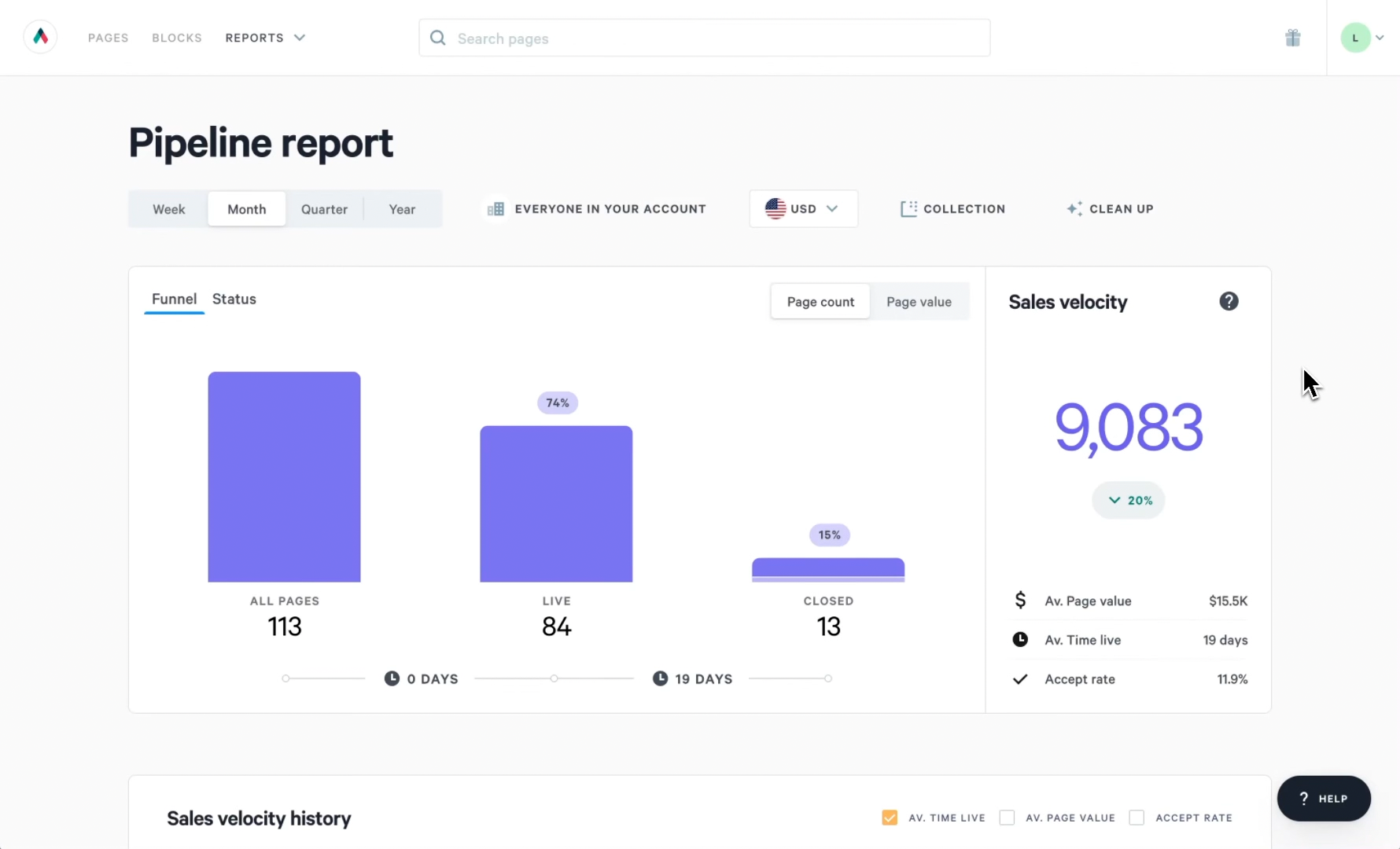
Improving pipeline visibility isn’t one big change. It’s a series of deliberate upgrades to how you define progress, collect data, and respond to signals.
1. Redefine pipeline stages around buyer commitments
This is the foundation. If your stages are wrong, everything built on top of them will be wrong too.
High-visibility pipeline stages describe buyer actions and commitments, not seller activities.
For example, instead of tracking internal milestones like calls completed or demos delivered, high-visibility pipelines focus on buyer commitments. A deal might only progress once the buyer has confirmed the problem exists, validated the proposed solution, engaged the economic buyer, or reviewed commercial terms. These moments reflect genuine forward motion, not seller effort.
Each stage should answer one question: What has the buyer done to earn this stage?
If the answer is vague, the stage is too.
2. Introduce explicit entry and exit criteria for every stage
Visibility improves dramatically when stages stop being suggestions.
For each pipeline stage, clarity comes from defining exactly what must be true for a deal to enter the stage, and what must be true for it to move on. This removes ambiguity from deal progression and gives managers something objective to inspect.
A deal either meets the criteria or it doesn’t, which dramatically reduces optimistic stage-jumping and creates a more trustworthy pipeline.
3. Shorten and enforce stage time limits
Time is one of the most honest indicators in your pipeline.
Deals that stall usually don’t recover. They quietly rot while looking technically “open.”
Set clear expectations for how long a deal should reasonably remain in each stage, and put mechanisms in place to flag or review deals that exceed those limits. Time-based signals force early conversations about momentum and fit, keeping the pipeline current enough to support real decision-making.
4. Make pipeline hygiene non-negotiable
Pipeline visibility depends on data quality. And data quality depends on discipline.
This means requiring only the fields that genuinely matter, running regular pipeline clean-ups, and making it clear that reps own the accuracy of their deals. Pipeline hygiene isn’t administrative busywork; it’s operational discipline. Without it, reports become stories rather than signals.
5. Separate pipeline volume from pipeline quality
A large pipeline is meaningless if it’s full of weak deals.
To improve visibility, teams need to track pipeline quality alongside pipeline volume. That includes whether economic buyers are engaged, whether timelines are confirmed, and whether deals are multi-threaded across stakeholders. These indicators reveal how real the pipeline is, not just how large it appears.
6. Instrument buyer engagement, not just seller activity
This is where most CRMs fall short.
Calls logged and emails sent tell you what reps are doing. They don’t tell you how buyers are responding.
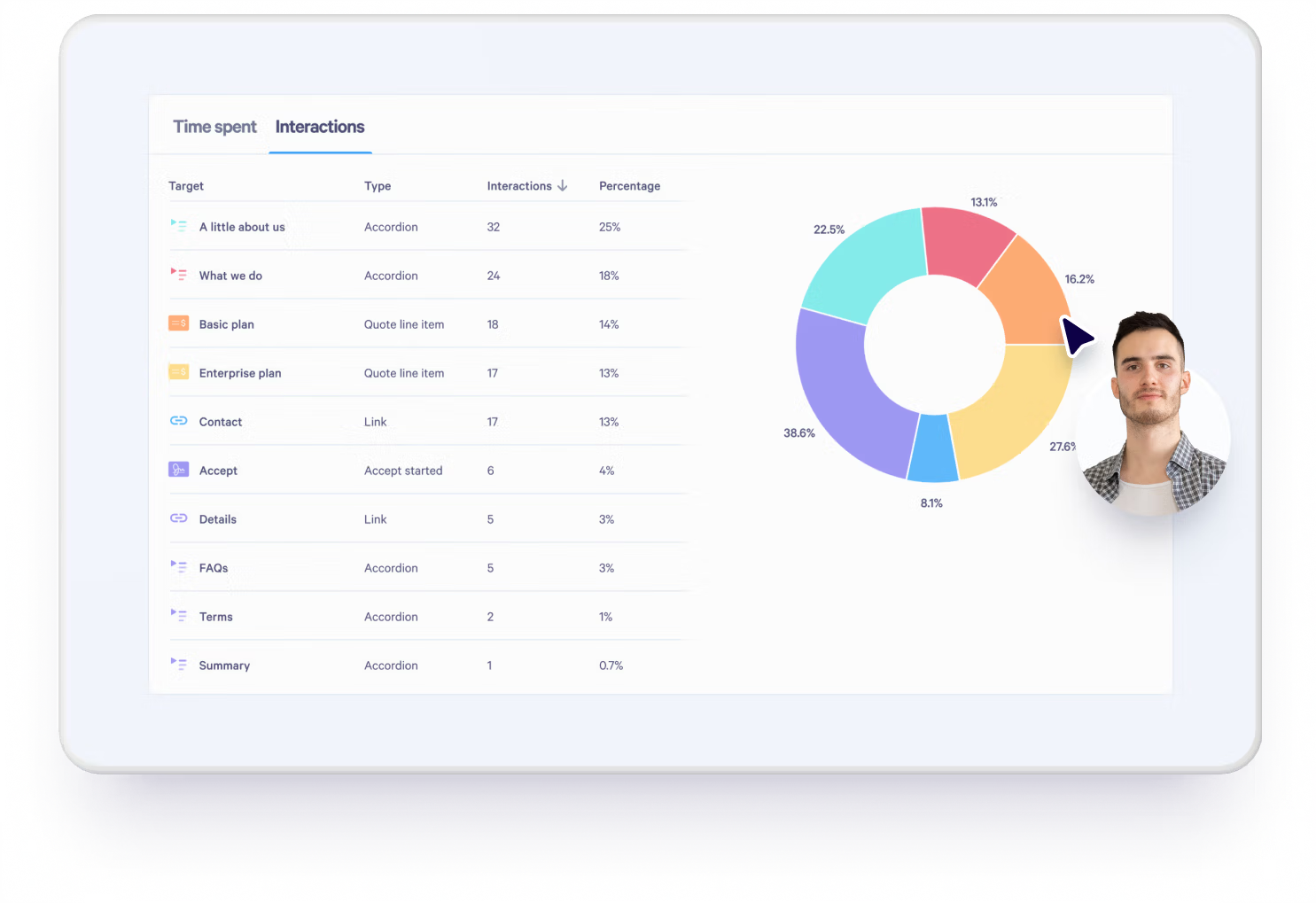
To truly improve visibility, teams need insight into how buyers are engaging. That includes whether sales content is being opened, shared internally, or ignored altogether, and how much attention buyers are paying to pricing and terms. Buyer behaviour is predictive of outcomes; seller effort on its own is not.
Tools like Qwilr help close this visibility gap by turning proposals and sales documents into interactive, measurable experiences rather than static files. Instead of guessing whether a deal is “active,” sales leaders can see engagement patterns that correlate strongly with momentum and risk.
This kind of visibility shifts pipeline management from opinion-based to evidence-based. Late-stage deals stop being black boxes, and forecast conversations move away from confidence and toward observable buyer behaviour.
7. Treat proposals as diagnostic tools, not closing documents
Most teams treat proposals as the final step. That’s a mistake.
A proposal should increase visibility, not end it.

When proposals are interactive and trackable, they provide answers to critical questions that static documents cannot. Teams can see whether a deal is active or stalling, whether new stakeholders have entered the conversation, and which sections are causing hesitation or friction. This turns proposals into early warning systems rather than final, opaque handoffs.
Most sales teams treat proposals as the final step in the process: a document sent, a follow-up scheduled, and then a wait. From a visibility perspective, this is a missed opportunity.
This is where platforms like Qwilr fundamentally change the role of proposals in the pipeline. Instead of a PDF that disappears into an inbox, proposals become live environments that reflect buyer engagement in real time. That insight helps teams identify friction early, address concerns proactively, and avoid being blindsided late in the quarter.
When proposals are treated as instruments rather than artifacts, the late-stage pipeline becomes more transparent and far easier to manage with confidence.
8. Build forecasting on evidence-based signals
Improving pipeline visibility naturally improves forecasting, but only if you change what forecasts are based on.
Instead of asking reps how confident they feel, stronger forecasts are anchored to observable signals. These include buyer engagement levels, adherence to stage criteria, and historical conversion rates. The more forecasting relies on evidence, the less it depends on optimism.

9. Coach to visibility, not just results
If reps only get feedback when deals close or slip, visibility won’t improve.
Coaching should focus on how deals progress, how stages are justified, which buyer signals matter, and where risks emerge. When reps learn that clarity and accuracy are valued just as much as closing, pipeline reliability improves quickly.
10. Review pipeline like a system, not a scoreboard
Pipeline reviews shouldn’t feel like interrogations.
The goal of pipeline reviews isn’t to pressure reps into optimistic commitments. It’s to identify systemic patterns: where deals consistently slow down, where buyers disengage, and where stages fail to reflect reality. When reviews focus on system health, visibility becomes a shared objective rather than a top-down demand.
How improved pipeline visibility changes the business
When pipeline visibility improves, several things happen quickly:
- Forecast accuracy increases
- Revenue surprises decrease
- Coaching becomes more effective
- Resource planning improves
- Sales and finance align more easily
Most importantly, leadership stops arguing about numbers and starts solving problems.
The hidden enemy of pipeline visibility: decision latency (and how to surface it)
Most pipeline visibility conversations stop at stages, data hygiene, and forecasting signals. They rarely address one of the most expensive blind spots in modern sales pipelines: decision latency.
Decision latency is the gap between buyer engagement and buyer decision-making. Deals look active on paper–meetings are happening, proposals are opened, emails are being exchanged - but no one is actually moving toward a decision. This is where visibility quietly breaks down, because traditional pipeline metrics aren’t designed to detect hesitation, internal politics, or unspoken objections.
High-visibility teams actively track decision momentum, not just activity. They ask questions like: Who owns the decision internally? What competing priorities could delay approval? What would cause this deal to stall even if the solution is right?
To surface decision latency, teams deliberately introduce moments that force buyer clarity. This might include mutual close plans, documented decision criteria, or explicit confirmation of approval paths. When buyers struggle to answer these questions, the deal hasn’t progressed, no matter how positive the conversations feel.
This approach turns ambiguity into a signal. Instead of assuming silence means progress, teams learn to recognise hesitation early and either re-engage strategically or downgrade the deal before it distorts the forecast.
Real-world deal scenario: when visibility actually changes outcomes
Pipeline visibility only matters when it changes how real deals are handled. Here’s what that looks like in practice.
A B2B SaaS company enters the final month of the quarter slightly behind target. Two enterprise deals sit in late-stage, both forecasted to close. On paper, the pipeline looks healthy, but leadership has learned not to trust optimism alone.
Instead of relying on rep confidence, the revenue team looks at buyer behaviour. One proposal shows repeated internal sharing, multiple revisits to pricing and security, and engagement from new stakeholders. The other, despite positive verbal feedback, shows almost no post-proposal activity.
With that visibility, leadership acts:
- Legal and finance are pulled into the highly engaged deal to remove friction early.
- The quiet deal is downgraded and reworked.
- One deal closes before month-end, the other slips - but the forecast holds, and the quarter lands exactly where expected.
Visibility didn’t create revenue. It removed surprises.
Qwilr: keeping every deal consistent—when it matters most
Pipeline visibility often fails late in the cycle because reps execute inconsistently. Pricing varies, legal terms are scattered, and proposals are structured differently. CRM data may look neat, but the buyer experience isn’t.
Qwilr enforces consistency at this critical stage through key features:
- Reusable templates: Ensure every proposal includes required scope, pricing, legal, and next steps - eliminating structural blind spots.
- Saved content blocks: Lock approved messaging, clauses, and pricing tables so deals don’t quietly drift off-model.
- Quote and pricing tables: Standardise how discounts, bundles, and totals are presented, making commercial risk easier to spot.
- Approval workflows: Prevent unapproved pricing or terms from entering the pipeline.
- Agreements & e-signatures: Capture formal buyer commitment inside the same workflow, removing uncertainty between “yes” and signed.
- QwilrPay: Make payment initiation a visible milestone, turning revenue intent into a trackable signal instead of an offline handoff.
- CRM integrations: Keep proposal, agreement, and payment activity aligned with Salesforce to preserve a single source of truth.
The result: every late-stage deal follows the same rules, reducing invisible risk, improving forecast accuracy, and making pipeline visibility reliable at scale.
Visibility is a discipline, not a dashboard
Pipeline visibility isn’t bought… It’s built. Clear definitions, enforced standards, buyer-focused tracking, and the courage to face uncomfortable truths create real insight. Dashboards only help if the underlying system reflects reality.
When your pipeline tells the truth, even when it’s inconvenient, you’re doing visibility right. If it doesn’t, no forecasting tricks will save the quarter. The good news? Sign up for a free trial, fix it early, and you rarely go back.
About the author

Brendan Connaughton|Head of Growth Marketing
Brendan heads up growth marketing and demand generation at Qwilr, overseeing performance marketing, SEO, and lifecycle initiatives. Brendan has been instrumental in developing go-to-market functions for a number of high-growth startups and challenger brands.